A Wheat Field in North America
The EmigrantsA Wheat Field in North America is the image through which Karl Oskar Nilsson first gives concrete form to emigration. Seen after a broken plowshare interrupts work on Korpamoen’s stony fields, the picture offers not merely an imagined destination but, to him, evidence of a real and radically different agricultural world. He carries it in his mind for weeks as he considers leaving, and its contrast between stone-bound home and abundant harvest helps turn dissatisfaction into a decision.
The picture and its setting
The picture reaches Karl Oskar in a borrowed paper he has brought home from the churchwarden’s. He handles the sheet carefully, wiping his fingers before touching it, as though it were a valuable deed. After breaking his plowshare in the rye stubble, he sits indoors instead of going to his workbench to make a replacement. Looking out at the unplowed field, he sees in the paper’s illustration a place almost opposite to the landscape outside his window.
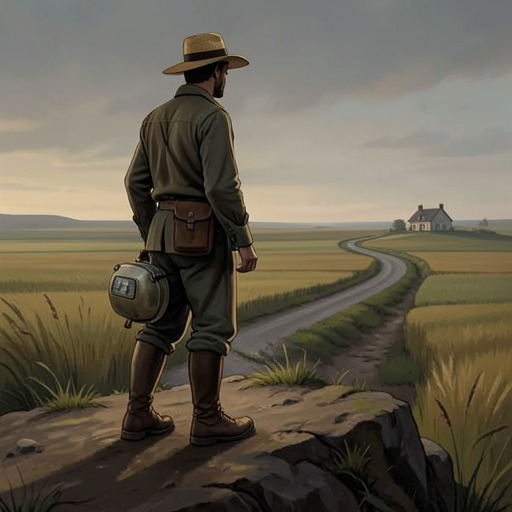
The pictured field is level and open, without fences or visible boundaries, stones, mounds, hills, or knolls. Its harvested ground appears smooth, while close-set shocks bear abundant sheaves with full heads of grain. Sunlight falls on a crop so plentiful that the field is compared to a sea of golden grain and an immense store of food. This is not simply a view of distant countryside: the illustration makes productive land legible in the quantities that matter to a farmer—seed, straw, sheaves, and bread.
From illustration to evidence
The printed caption says that work-willing farmers have good prospects of future success in the United States. But Karl Oskar’s confidence rests especially on the picture itself. Stories can be invented and descriptions can be inaccurate, he reasons; a picture, by contrast, must show something that exists somewhere. If the field has been pictured, then its fertile ground and heavy wheat have existed in the world. For him, the image turns America from hearsay into a place whose agricultural possibilities can be trusted.
That certainty is emotionally and materially grounded in Korpamoen. Karl Oskar owns seven acres in stony country, and the plowshare breaks while he works the rye stubble. He sees the contrast not as an abstract difference between two lands but as a challenge to the conditions under which he farms. The ideal field in the illustration seems free of the obstacles that define his own ground; its abundant crop proposes an alternative to labor repeatedly checked by stones and poor prospects.
The picture also takes on a sacred quality in the way he regards it. Sitting quietly, Karl Oskar holds the sheet before him as carefully as a churchgoer holds a psalmbook. The image’s harvest suggests that the soil of the New World remains blessed, unlike the Old World’s ground, which he understands as cursed because of human sin. The agricultural contrast therefore becomes a moral and religious one as well: abundance appears not only desirable, but evidence of a different condition of the earth.
The image becomes a decision
The broken plowshare is the immediate occasion on which the picture’s influence begins. Karl Oskar has not simply lost a tool; the mishap brings the frustrations of his farming into focus. The illustration stays with him through many days and nights, while he considers the move with the seriousness he associates with a major legal or financial decision. He does not decide in a moment of anger: he takes several weeks to weigh the choice.
At first he shows the picture only to Kristina, who looks at it casually. She does not know that he carries its image with him wherever he goes. During the long autumn evenings, while he whittles handles and rake teeth and she works wool and flax, Karl Oskar prepares himself to raise the question of moving. He has already decided that he wants to go and has mentally considered the objections she might make; he then asks what she thinks. The picture thus precedes the conversation that brings his private conviction into the household, even though the evidence does not make it the sole cause of the family’s decision.
Material memory and the departure
Once the family prepares to emigrate, the imagined abundance of the picture meets the practical limits of what they can carry. They must choose a small load for a long journey and an uncertain life after landing. In the America chest, Karl Oskar packs tools for timber work and carpentry, as well as a disassembled muzzle-loader; Robert adds fishing gear. Kristina must leave behind familiar implements, including her loom and spinning wheel, while bringing the equipment and supplies she judges essential. The picture’s expansive, almost boundless field is therefore set against the cramped, selective work of packing for a real crossing.
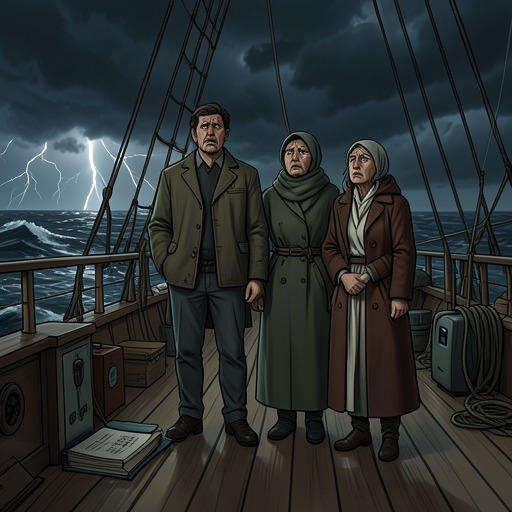
The family’s departure gives the image a further contrast: leaving a known landscape is not the same as arriving in the one the picture promises. As the wagon sets out, Karl Oskar sees his parents remain on the porch, while he and Kristina travel with the children. At the harbor the emigrants encounter water with no land visible across it; aboard the Charlotta, Robert and Arvid measure a vessel only forty paces long and eight wide, space shared by almost a hundred people. Contrary winds later stretch the crossing into a succession of days, making both the homeland and the hoped-for destination seem remote. The picture’s boundless field becomes a powerful counterimage to the narrow ship and uncertain passage, without guaranteeing what the emigrants will find.
Significance
The image gives Karl Oskar a way to test the stories he has heard about America against something he regards as concrete proof. Its particular force lies in the tension between representation and certainty: a printed field is not the land itself, yet he trusts that it must correspond to a real place. That conviction helps him imagine leaving, but the narrative keeps the imagined destination distinct from the hardships and uncertainties of reaching it.
As a remembered object, the picture is also bound to the material world it seems to transcend. Karl Oskar first sees it in a borrowed sheet, handles it with unusual care, and returns to its image in thought while continuing the ordinary work of the farm. Later, the family’s tools, clothes, food, and chests make migration a matter of weight, space, and what can be carried. Against those finite things, the open harvest in the picture remains a vision of room and possibility: the image that gives a farmer’s decision its first persuasive shape, even as the journey tests the hope it represents.